
Leading for Employee Wellbeing
Written by David Robb – Co Owner / Managing Partner

Employee wellbeing has become one of the most pressing leadership priorities in today’s workplace. Rising stress, burnout, and disengagement continue to impact organizations across industries. Studies show that nearly 40% of employees feel overworked or undervalued, and 95% of Gen Z workers report struggling with their wellbeing.
Chronic stress affects not only individuals but company performance, contributing to absenteeism, turnover, and lowered productivity. Leaders and HR professionals are now tasked with supporting performance and creating an environment where people feel valued, connected, and motivated.
This guide explores how leadership shapes wellbeing, how workplace culture influences stress, and practical ways managers can help teams thrive.
Why Leadership Plays a Large Role in Employee Wellbeing
Employees look to their leaders for direction, support, and connection. Multiple global studies show that managers have one of the strongest influences on day-to-day mental health, sometimes on par with family relationships.
When leaders communicate clearly, provide meaningful feedback, and foster trust, they create conditions where employees feel capable and confident. When communication is inconsistent or expectations shift without clarity, stress rises quickly.
Understanding Stress: The Difference Between Eustress and Distress
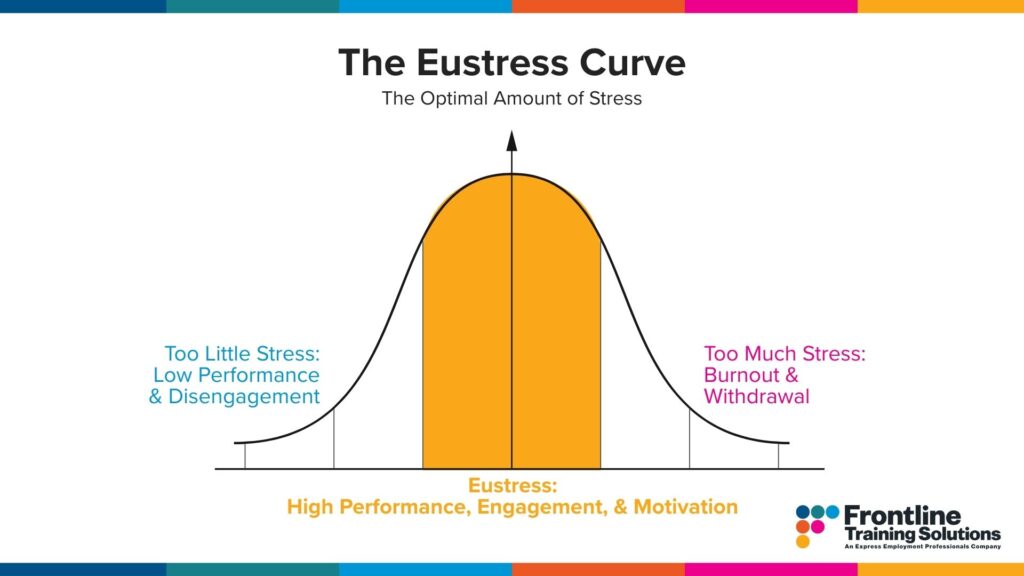
Stress is often discussed as something purely harmful, but that isn’t always the case. A moderate amount of challenge, known as eustress, can increase motivation, creativity, and engagement.
- Too much stress: leads to overwhelm, burnout, or withdrawal.
- Too little stress: leads to boredom or disengagement.
- Eustress: sparks growth, confidence, and momentum.
Managers create eustress by assigning attainable challenges, offering guidance, and giving employees room to grow. When leaders understand this balance, they strengthen job satisfaction and performance.
How Workplace Culture Shapes Stress and Performance
Workplace stress doesn’t come only from workload; it also stems from how the organization operates. Culture shapes the meaning employees attach to their work, the clarity they feel in their role, and the connection they experience with the company’s purpose. When those pieces are unclear or missing, stress rises even when day-to-day tasks haven’t changed.
On the other hand, when people understand why their work matters, how they fit into the larger strategy, and what the company stands for, their sense of importance increases, and stress often decreases. A strong culture provides context, belonging, and confidence, all of which help employees navigate challenges more effectively.
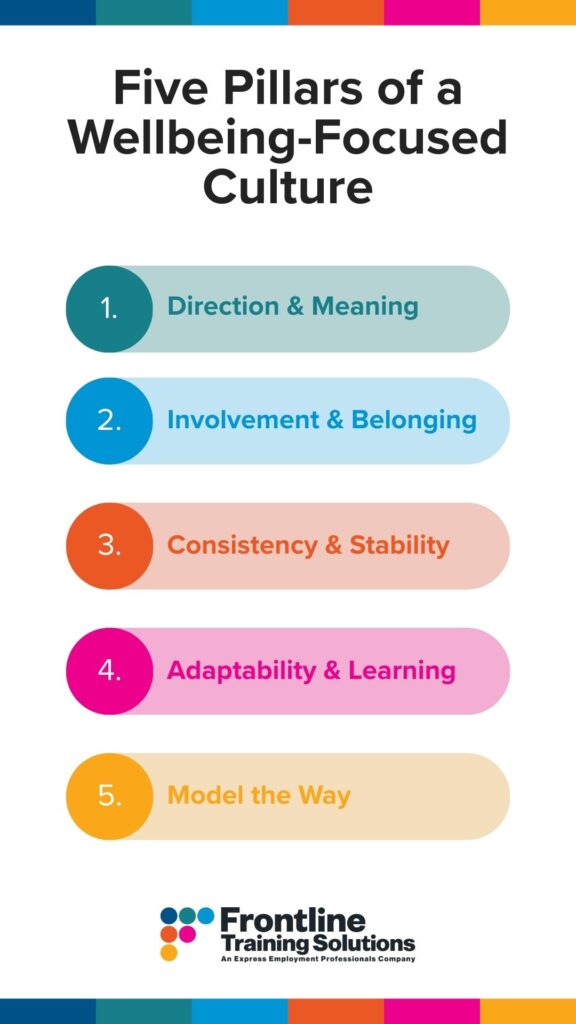
These cultural elements set the stage for the five pillars of well-being that follow. Each pillar reflects a core component of a healthy culture: clear direction, meaningful involvement, consistent expectations, space for learning, and leaders who model the values of the organization.
Five Pillars of a Wellbeing-Focused Culture
Leaders influence wellbeing not through one action but through consistent behaviors that build trust, clarity, and connection. These five pillars offer a practical roadmap.
1. Direction & Meaning
Employees want to know their work matters. Leaders strengthen purpose by:
- Connecting daily tasks to company goals
- Communicating progress and celebrating milestones
- Providing clarity on expectations
When employees see how their work impacts customers or communities, motivation and engagement rise.
2. Involvement & Belonging
Belonging is a major contributor to wellbeing. Employees want influence in decisions that affect their work and a sense of partnership in reaching shared goals.
Leaders reinforce belonging by:
- Encouraging feedback and ideas
- Bringing teams into problem-solving
- Setting mutual goals
- Creating a culture where it is encouraged and safe for individuals to take personal accountability of their work.
People feel valued when they know their contributions matter.
3. Consistency & Stability
Uncertainty increases stress, even in strong performers. Leaders offer stability by:
- Sharing updates early
- Offering clear expectations
- Making roles and processes easy to understand
- Communicating openly during change
Consistency builds trust, especially during transitions.
4. Adaptability & Learning
People thrive when they feel challenged yet supported. Leaders strengthen adaptability by:
- Encouraging experimentation
- Framing mistakes as part of learning
- Providing training and stretch assignments
- Pairing expectations with coaching and clarity
These conditions create psychological safety and drive growth.
5. Model the Way
The actions of leaders shape the culture more than policy ever will. Employees observe how their leaders communicate, set boundaries, react to challenges, and treat others.
- Taking breaks without guilt
- Handling conflict with calm and clarity
- Showing appreciation consistently
- Maintaining healthy boundaries
- Making thoughtful decisions even under pressure
When leaders demonstrate steadiness and self-awareness, others follow.
Leadership Self-Care: A Prerequisite for Supporting Others
Leaders cannot support their teams effectively if they are depleted. Self-care enables clarity, emotional steadiness, and better decision-making.
Healthy practices may include:
- Protecting time for rest and reflection
- Choosing boundaries that allow for sustainable performance
- Regular movement or time outdoors
- Activities that restore energy
- Nourishing connections with colleagues and peers
- Mindfulness or journaling when helpful
Self-care looks different for each person, but intentionality is the common thread.
Learn to Lead for Wellbeing with Frontline Training Solutions
Supporting employee wellbeing is not a one-time effort. It’s a leadership practice strengthened by training, reflection, and development.
Frontline Training Solutions helps leaders create workplaces where people feel supported, connected, and motivated. Our programs address communication, coaching, accountability, and culture, all central to wellbeing.
Ready to Start?
Strengthen Your Team's Wellbeing
Watch our free Leading for Wellbeing webinar to get practical guidance you can apply right away. If you’d like help bringing these practices into your workplace, our team is here to talk through your goals and next steps.
Explore More Resources
Frontline has everything you need to know about training your team to get stronger and rise to every work challenge. Explore our webinars, podcast, magazine, and more blog posts today!
About the Author

David Robb – Co Owner / Managing Partner
David Robb is an entrepreneur and business leader with extensive experience in the staffing and recruiting industry, workforce development, and economic/labor market dynamics. David is the Co-Owner and Managing Partner of Express Employment Professionals of Grand Rapids, Michigan. Express Employment Professionals is the largest privately held staffing company in the country and the Grand Rapids office consistently performs in the top 2% of all franchises. Since joining the Express team in 2015, David has partnered with Founder Janis Petrini to also launch and lead Specialized Recruiting Group and Frontline Training Solutions. Between their group of three companies they assist clients with all levels of staffing services and executive recruitment as well as employee training, HR consulting, and workforce strategy. Across all three companies, David leads a team of over 35 employees, serving clients both locally and across the country. Previously, David worked as the Director of Data Analysis at a top digital advertising agency. David has degrees in Business Administration and Economics from Calvin University. David is a sought-after speaker on economic conditions and labor market forecasts. He is also a regular contributor and featured expert on various local and national business publications. He serves on the Western Michigan Economic Roundtable for the Federal Reserve, the Grand Rapids Chamber Workforce Development Committee, and is actively involved in a variety of local non-profits.