
The Stages of Team Development—and Why Managers Shape the Outcome

Most leaders have seen it happen.
A new team starts out upbeat and polite. A few months later, tension creeps in. Deadlines slip, communication feels strained, and people who once seemed aligned now pull in different directions. Performance drops, frustration rises, and retention suddenly feels at risk.
This pattern is not a sign of failure. It is a normal part of how teams develop.
Understanding the stages of team development gives managers a way to make sense of these shifts and respond with intention. Teams do not move forward on their own. Leadership behavior plays a central role in whether teams stall, regress, or grow.
Why Team Dynamics Matter More Than Most Leaders Realize
Workplace conflict is costly. Peer-reviewed research shows that employees in the U.S. spend an average of 2.8 hours per week dealing with conflict, translating to an estimated $359 billion in lost time each year.
Much of that burden lands on managers.
Instead of focusing on priorities, managers find themselves refereeing interpersonal issues, mediating misunderstandings, and revisiting decisions that never truly stuck. Often, the root problem is not conflict itself, but the lack of early alignment on relationships, expectations, and shared goals, especially when new team members join.
Day-to-day experience lives inside the team.
Team dynamics and performance are deeply connected. When trust is low or communication patterns are unbalanced, progress slows and frustration builds. When relationships are strong and expectations are clear, motivation and commitment follow. This is why leaders who understand team development are better positioned to retain strong contributors.
A Practical Look at the Four Stages of Team Development
Bruce Tuckman’s model, often referred to as the four stages of team development, has shaped how leaders understand team dynamics for decades. The model describes a predictable progression: forming, storming, norming, and performing.
Its value is not theoretical. It gives managers shared language to interpret what they are seeing and respond with purpose rather than frustration.
Teams do not move through these stages in a straight line. Reorganizations, new hires, shifting priorities, or increased pressure can send a team back into earlier stages. What matters is recognizing where the team is now and adjusting leadership behavior accordingly. Below are observations of teams in each respective stage and recommendations for what approach leaders should take in each stage.
Forming: Lay the Foundation
In the forming stage, teams are getting oriented. Surface politeness often masks uncertainty. Roles are still unclear, and early commitments may reflect optimism more than understanding.
What Managers Often See
- Hesitant sharing and limited pushback
- Cliques beginning to form
- Early discussions about process that lack follow-through
What Helps at This Stage
Managers set the tone here. Moving quickly to clarify why the team exists, what success looks like, who owns what, and how decisions are made reduces anxiety and builds early trust. Co-creating simple agreements around goals, interaction norms, and communication cadence gives teams something concrete to anchor to.
Research from MIT, highlighted in Harvard Business Review, shows that balanced communication patterns—equal participation, direct member-to-member connections, and energetic exchanges—account for a meaningful share of performance differences. Seeding those habits early matters.
Storming: Navigate the Inevitable Conflict
Storming is where many teams struggle.
As real work pressure builds, differences in priorities, communication styles, and expectations surface. Power dynamics emerge. Progress may slow as energy shifts toward disagreement instead of execution.
What Managers Often See
- Open arguments or subtle coalition-building
- “Agreement” that disappears under pressure
- Frustration around roles or workload balance
This stage is not a problem to eliminate. It is a phase to guide.
What Helps at This Stage
Managers who avoid conflict or try to shut it down often extend storming. Staying present but neutral helps teams work through tension productively. Anchoring debate to business outcomes, reinforcing behavioral norms from forming, and coaching active listening keeps conversations focused.
An important discipline here is diagnosis. A single person resisting accountability can look like team-wide dysfunction. Likewise, endless debate often points to unclear decision rights or competing priorities. Treating individual issues as team problems, or vice versa, wastes time and erodes trust.
Storming is also where team dynamics and retention begin to intersect. When people feel unheard or blamed, disengagement starts quietly.
Norming: Integrate What Works
As teams move through conflict, rhythm begins to emerge. Communication becomes more direct and constructive. The team starts to align on “how we do things here.”
What Managers Often See
- Improved coordination and follow-through
- Clearer roles and steadier output
- Milestones reached more consistently
What Helps at This Stage
At this stage, the manager role in team development shifts. The work is less about directing and more about facilitating. Recognizing and reinforcing productive norms while they are fresh helps them stick. Encouraging side conversations and cross-checks strengthens collaboration without adding bureaucracy.
Leadership value now comes from removing obstacles, not setting direction for every decision.
Performing: Enable Self-Sufficiency
In the performing stage, teams operate with confidence. Members understand each other’s strengths, compensate for gaps, and handle conflict internally. Results come more quickly, and setbacks do not derail forward momentum.
What Managers Often See
- Strong outcomes with resilience
- Balanced communication without prompting
- Less reliance on the leader for day-to-day coordination
What Helps at This Stage
The manager’s presence still matters, but it looks different. Protecting focus, stretching the team with meaningful goals, and watching for signs of fatigue keeps performance sustainable. At this point, the leader acts more as sponsor than supervisor.
High-performing teams are not conflict-free. They are skilled at working through challenges together.
The Manager’s Discipline: Diagnose Before Acting
One of Tuckman’s lasting contributions is shared language.
Saying, “We are storming around decision rights,” creates perspective and direction that “this team cannot collaborate” never will. It shifts managers from firefighting interpersonal noise to addressing the real work of alignment.
Three reminders help managers stay grounded:
- Individual vs. collective: Not every issue is a team problem. Address individuals when accountability is the real concern.
- Symptoms vs. roots: Persistent debate often signals unclear roles or priorities, not poor intent.
- Not always linear: Team development resets during major change. Revisit alignment when conditions shift.
Used thoughtfully, the stages of team development move leadership from intuition to method. Expect messiness. Intervene with purpose. Celebrate progress.
Teams do not become high-performing by accident. They are coached there.
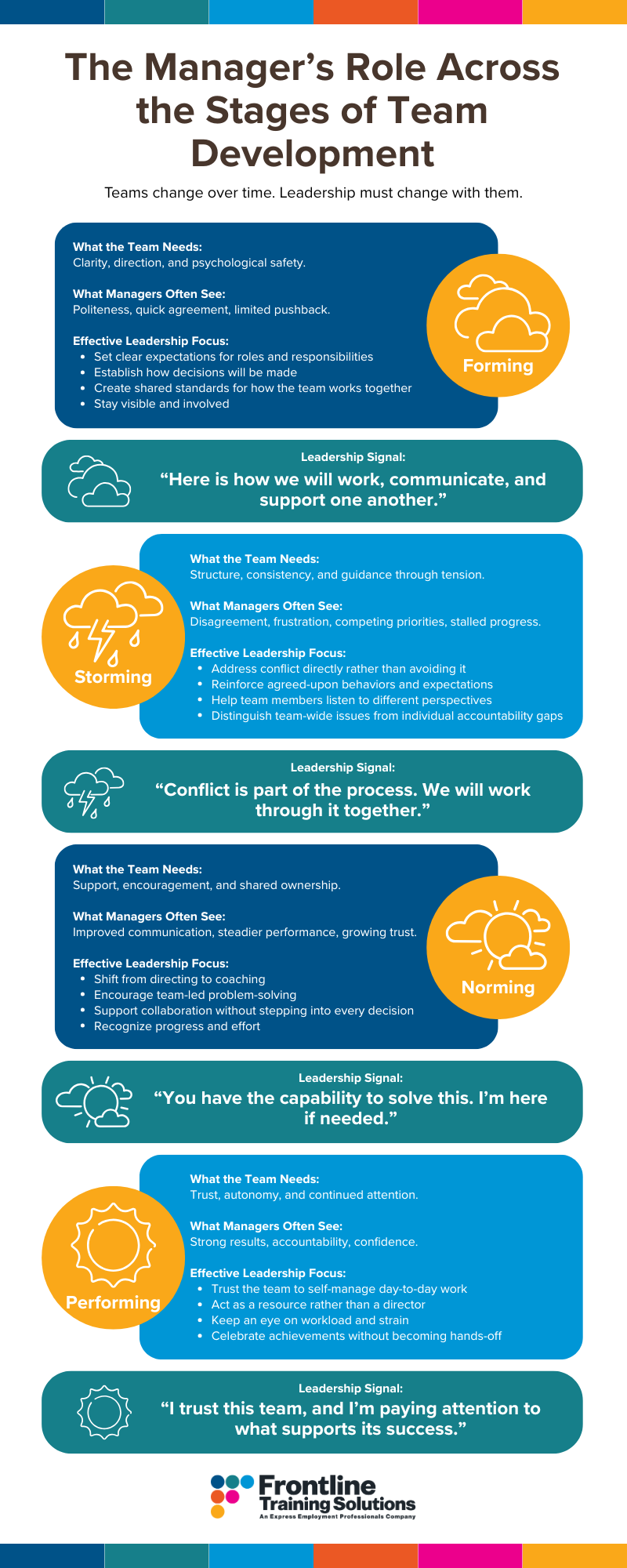
Click here to download a PDF printer-friendly version of this infographic.
How Team Dynamics Affect Retention
When leaders ask why people leave, answers often point to workload, stress, or growth. Underneath those reasons is usually a team experience problem.
Poor dynamics drain energy. Unresolved tension creates frustration. Lack of clarity leads to burnout.
Strong dynamics do the opposite. People feel supported, understood, and part of something that works. This is why team dynamics matter so much to retention. Employees stay when they trust their manager, feel heard by teammates, and see how their work connects to shared goals.
Retention rarely breaks all at once. It erodes through daily interactions inside teams.
Awareness Comes Before Improvement
Managers do not need to diagnose every behavior or label every conflict. What matters is awareness.
Knowing which stage of team development a team is in helps leaders respond with intention instead of reaction. It clarifies whether an issue reflects individual behavior or a broader team pattern. It also reduces the temptation to overcorrect.
Teams that grow well do so because leaders pay attention to how the team is functioning, not just what the team is producing.
Ready to Start?
Strengthen Team Dynamics With the Right Insight
Understanding the stages of team development is a starting point. The real impact comes from knowing how leadership behavior shapes trust, engagement, and performance as teams move through each stage.
Frontline supports managers and HR teams with training, webinars, and practical tools that focus on how teams actually work together day to day.
Watch our Retention Starts with Team Dynamics webinar to explore how interpersonal skills, team relationships, and leadership choices influence engagement, motivation, and long-term commitment, along with practical ways to assess and strengthen your team’s dynamic.
Explore More Resources
Frontline has everything you need to know about training your team to get stronger and rise to every work challenge. Explore our webinars, podcast, magazine, and more blog posts today!
About the Author

Ryan Williams – Leadership & Team Development Manager
Ryan Williams serves as the Leadership & Team Development Manager at Frontline Training Solutions. He is a certified Everything DiSC facilitator and has his master’s in organizational leadership from Cornerstone University. Ryan brings a wide variety of cross-cultural leadership experience, having worked previously in Hong Kong and with Native Alaskans. Most recently, Ryan has worked in higher education, developing and implementing training curriculum and programs across the organization. Ryan’s passion and focus is for everyone to love the place they work. People who love their workplace, work harder and perform better. He brings a unique perspective in helping organizations evaluate their organizational culture, understand cross-cultural dynamics, and implement strategies to create better leaders