
The Workforce Ahead: Talent Trends, AI, and the Challenges Shaping the Next Decade
Written by David Robb – Co Owner / Managing Partner

The labor market in early 2026 looks very different than it did just a few years ago. Hiring has cooled, layoffs remain low, and for the first time in years, the U.S. labor market is roughly back in balance.
But underneath those headline numbers, the workforce is shifting in ways that will define the next decade of hiring, retention, and leadership. Demographic decline, AI adoption, and a widening skills gap are converging at the same time. For HR and operations leaders trying to plan three to five years out, the real question isn’t where the market is today. It’s where these trends are headed, and what to do about it now.
Where the Labor Market Sits Today
A “Low-Hire, Low-Fire” Environment
Hiring demand has cooled throughout 2025. Job openings have come down, but layoffs remain relatively low. Voluntary turnover has dropped sharply, too, with many employees moving from job hopping to job hugging.
For employers, that has translated into less urgency. For job seekers, less confidence. Roles get posted, pulled, and reposted. Applicants frequently report the process moving more slowly than they’re used to.
The Market is Roughly in Balance
According to the Bureau of Labor Statistics, the ratio of unemployed workers to job openings hit 1.0 in July 2025, the closest the market has been to balance in years. By late 2025, unemployed workers slightly outnumbered job openings for the first time since the pandemic recovery began.
This isn’t a massive surplus, but it is a shift. And it’s unlikely to last.
A Surplus on Paper, a Shortage in Reality
Even with macro numbers near break-even, employers across multiple sectors are still struggling to fill roles with the right people. The headline figures don’t capture the misalignment underneath: between the skills employers need and the skills available, between where the jobs are and where the workers live, and between the kinds of work being created and the kinds of work people are trained for.
Three areas show that misalignment most clearly.
Skilled Trades and Manufacturing
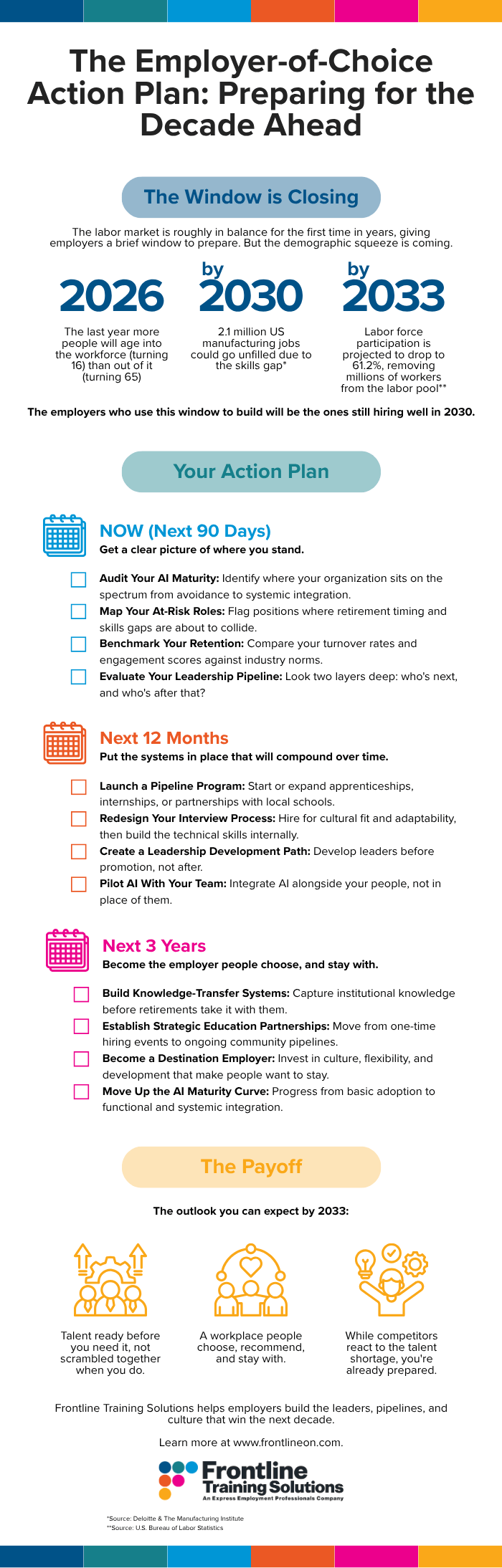
According to a Deloitte and Manufacturing Institute study, the U.S. manufacturing skills gap could result in 2.1 million unfilled jobs by 2030, at a potential cost of $1 trillion to the economy. Roles like maintenance technicians, CNC machinists, and industrial electricians are among the hardest to fill.
The driver isn’t surging demand. It’s the combination of a retiring workforce and a thin pipeline behind them. Roughly half of workers in many skilled roles are over 50.
Healthcare
Healthcare has been the fastest-growing sector in the U.S. economy. The Bureau of Labor Statistics projects healthcare and social assistance to grow 8.4 percent from 2024 to 2034, the largest job growth and fastest growth of any sector.
Healthcare faces a compounding workforce crisis: the same generation aging out of the profession is simultaneously driving demand for care. With training pipelines unable to keep pace with retirement-driven vacancies, and chronic turnover further depleting the direct care workforce, employers have little margin to absorb these losses — making strategic workforce planning not just beneficial, but essential.
Entry-Level White-Collar Work
On the opposite end, there’s a growing surplus of recent grads and early-career professionals competing for fewer entry-level openings. AI is already absorbing many of the tasks these roles used to handle.
The result: employers and candidates are both rethinking what “getting your foot in the door” looks like.
The Takeaway
A national-level surplus doesn’t mean your specific roles are easier to fill. For most employers, certain positions are actually getting harder to fill.
The Demographic Trend Driving Everything Else
If there’s one statistic that explains the long-term direction of the U.S. workforce, it’s the labor force participation rate (the percentage of the civilian working-age population that is employed or actively seeking employment). That number peaked around the year 2000 and has been on a steady decline since.
What the Numbers Show
Pre-pandemic, the labor force participation rate sat at 63.3 percent. The BLS now projects it will fall to 61.2 percent by 2033.
That gap may sound small, but it represents millions of workers who simply won’t be in the labor pool.
The Aging Population
The biggest driver is demographic. Baby boomers are retiring out, and the generation entering behind them is smaller.
The U.S. fertility rate has been at or below the replacement level of 2.1 since the early 1970s, and in 2024 it dropped to a record low of 1.6 children per woman. Projections for the future workforce aren’t guesses, they’re demographic math. The kids born sixteen years ago are the workers entering the labor force today.
The Crossover Year
2026 is projected to be the last year where slightly more people age into the workforce (turning 16) than age out of it (turning 65). After that, the gap inverts and keeps widening.
Immigration has historically helped close that gap, but as a policy lever it’s unpredictable, which makes it hard to plan around.
The Succession Wrinkle Most Plans Miss
There’s also a wrinkle most succession plans don’t account for: the assumption that today’s senior leaders will stay in their roles for another decade.
Many won’t. Whether by choice or by financial necessity, retirement timing is shifting. Some leaders are looking to glide out earlier than 65; others are staying longer to make ends meet, but with less full-time intensity. Either way, the leaders’ organizations have lined up as successors may themselves be only a few years from their own transition. The right question isn’t just “who’s next?” It’s “who’s after that?”
AI in the Workforce: Help, Not a Silver Bullet
Every conversation about workforce trends right now eventually lands on AI. The honest answer to “will AI solve the talent shortage?” is: yes and no.
Why “Yes”
AI is already reshaping work, globally, across industries, and at a faster pace than most organizations are formally tracking. Productivity gains, automation of routine tasks, and entirely new workflows are all real and measurable.
Why “No”
AI isn’t going to fully offset the demographic gap. Many companies that initially planned to use AI to eliminate roles are finding that the actual outcome is different. Efficiencies appear, but the work is shifting rather than disappearing.
If a team has 20 percent less of its old work to do, there’s often 20 percent of new or previously deferred work waiting to absorb the capacity.
How Impact Varies by Sector
The impact also varies sharply by industry.
IT, Tech, Finance, Insurance, Entertainment
AI is already lifting productivity. Talent shortages here are likely to be relatively mild, and in some cases, hiring will slow.
Education
Mostly insulated from AI displacement in the near term. Demand pressure here comes from a different direction: a smaller school-age population is reducing the need for teachers and institutions.
Manufacturing, Retail, Trade, Food Service, Hospitality, Utilities
Hands-on, in-person work where AI helps but doesn’t replace people. These sectors face the steepest combined pressure from demographic decline and existing pipeline gaps.
Construction and Healthcare
Likely to feel the most acute talent shortages. The work is physical and people-centric, demand is rising, and the supply pipeline is thin.
The Most Overlooked Factor
Beyond sector, three other factors shape an organization’s exposure to AI: geography, job function, and the company’s own adoption posture.
That third one is the most important and least discussed. The biggest variable in how AI affects your workforce isn’t the technology. It’s whether your leaders are actively integrating it or quietly hoping it goes away.
The AI Maturity Spectrum
Most organizations land somewhere on a spectrum:
- Avoidance: Heads in the sand, no usage, active resistance
- Awareness: Reading, listening, paying attention to what’s happening
- Basic adoption: Using AI for simple tasks like brainstorming or summarizing
- Functional integration: AI woven into communication, analysis, and process improvement
- Systemic integration: AI built into HR systems, learning platforms, CRMs, and operational workflows
The strategic question isn’t whether you’re behind. Most companies are. It’s what you’re doing this quarter to move up.
Rethinking Talent Strategy for the Decade Ahead
Pull these trends together and the picture is clear. The talent surplus is temporary. The demographic squeeze is permanent. AI will help maximize a smaller workforce, but it won’t replace it.
The employers who will be most competitive over the next ten years are the ones using this current breathing room to prepare their workforce strategy. Here are the moves that matter most.
Build a Real Talent Pipeline
External hiring alone won’t close the gap. The most prepared organizations are pairing external recruitment with intentional internal pipelines, including apprenticeships, internships, mentorship programs, and partnerships with local high schools and community colleges.
Some manufacturers are now pitching parents directly: a paid four-year apprenticeship with a journeyman certification at the end, versus a four-year degree with $50,000 in debt. That kind of long-view thinking is what a great pipeline looks like.
Hire for Fit, Then Develop the Skills
The old interview format, focused almost entirely on technical competencies, is no longer enough. Technical skills change quickly, and increasingly they can be taught. What’s harder to train for is cultural fit, interpersonal capability, and adaptability.
The most competitive employers will be the ones who hire people they can grow, and build the systems to actually grow them: train-the-trainer programs, knowledge-transfer processes, and structured upskilling paths.
Rethink Workforce Design Around People
When AI changes what a role does, the most successful organizations aren’t eliminating the person. They’re redesigning the role around them, especially when the person brings strong cultural or leadership value.
The principle that consistently shows up among healthy adopters: do AI with your team, not to your team. Leaders who model new ways of working themselves earn the credibility to ask their teams to come along.
Invest in Leadership Development
Almost every workforce challenge traces back to leadership: retention, engagement, change management, succession.
The pace of change isn’t going to slow. Strong leaders are what make change manageable rather than chaotic. Developing leaders earlier, more intentionally, and at every level of the organization is one of the highest-leverage investments an employer can make right now.
Become an Employer of Choice
Here’s a simple test for whether you’re an employer of choice. When employees mention where they work at a community event, a kid’s game, or the grocery store, do faces light up, or do they wince?
The answer is shaped by culture, leadership quality, learning and development opportunities, flexibility, and a clear sense that the company is investing in its people for the long term. According to Deloitte’s 2025 Gen Z and Millennial Survey, learning and development ranks among the top three reasons younger workers choose their current employer, with only 6 percent of Gen Z citing reaching senior leadership as their primary career goal.
Investing in development is one of the few strategies that builds both the talent you need and the retention to keep it.
The Bottom Line
The current pause in hiring isn’t the new normal. It’s a window.
The demographic curve, the AI adoption curve, and the skills-gap curve are all converging. The employers who come out ahead will be the ones who treat the next two to three years as time to build: stronger pipelines, better leaders, more thoughtful AI integration, and a workplace people genuinely want to be part of.
Ready to Start?
Go Deeper on the Workforce Trends Shaping Your Industry
If you’re ready to dig further into where the workforce is headed and what it means for your hiring, retention, and leadership development strategy, watch our on-demand webinar with Frontline’s David Robb and Mike Lee. They walk through the demographic data, the realistic role of AI, and the specific moves employers can make right now to stay ahead of the talent shortages still to come.
Explore More Resources
Frontline has everything you need to know about training your team to get stronger and rise to every work challenge. Explore our webinars, podcast, magazine, and more blog posts today!
About the Author

David Robb – Co Owner / Managing Partner
David Robb is an entrepreneur and business leader with extensive experience in the staffing and recruiting industry, workforce development, and economic/labor market dynamics. David is the Co-Owner and Managing Partner of Express Employment Professionals of Grand Rapids, Michigan. Express Employment Professionals is the largest privately held staffing company in the country and the Grand Rapids office consistently performs in the top 2% of all franchises. Since joining the Express team in 2015, David has partnered with Founder Janis Petrini to also launch and lead Specialized Recruiting Group and Frontline Training Solutions. Between their group of three companies they assist clients with all levels of staffing services and executive recruitment as well as employee training, HR consulting, and workforce strategy. Across all three companies, David leads a team of over 35 employees, serving clients both locally and across the country. Previously, David worked as the Director of Data Analysis at a top digital advertising agency. David has degrees in Business Administration and Economics from Calvin University. David is a sought-after speaker on economic conditions and labor market forecasts. He is also a regular contributor and featured expert on various local and national business publications. He serves on the Western Michigan Economic Roundtable for the Federal Reserve, the Grand Rapids Chamber Workforce Development Committee, and is actively involved in a variety of local non-profits.