
One-Way vs. Two-Way Communication
Written by David Robb – Co Owner / Managing Partner

A plant manager announces a new shift schedule at the all-hands, and on Monday half of the second shift arrives at the old time. A project lead warns in three Friday updates that a late part could delay the project, but the warning sits at the bottom of a long email and asks no one to act. Two supervisors leave a meeting with opposite ideas of what was decided. In each case, someone delivered a message and assumed the job was done.
All three stories share a root: a message sent is not a message understood. The gap is common. Gallup’s August 2026 polling put the share of U.S. employees who strongly agree that their leadership communicates effectively at 16%. Managers and their teams also see it differently: 44% of managers were sure they communicate company priorities clearly, a view only 26% of individual contributors strongly shared.
Closing the gap starts with naming which kind of communication broke down. Some messages fail in the delivery. Others fail because nobody had a chance to respond. Each failure takes a different skill to fix.
What Is One-Way Communication?
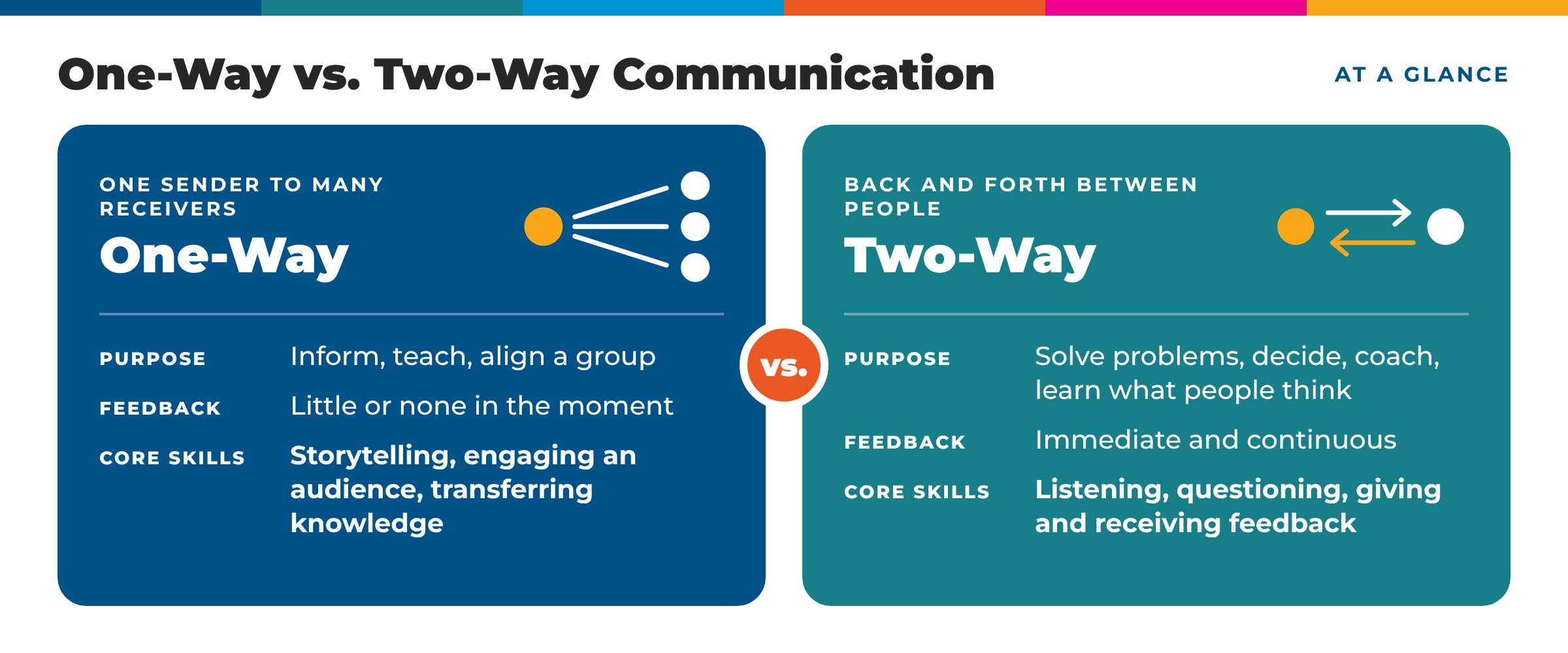
One-way communication is one person delivering a message to a group. The speaker talks, and the audience receives. Employee meetings, safety briefings, a session that teaches a new process, and project report-outs all fit the definition. So do emails, memos, and posted announcements.
The skill is making the message land. A good presenter tells a story the audience can follow, holds the room’s attention, and transfers knowledge so that people remember it and use it. Slide design is a small part of that skill, and so is getting past nerves. A calm speaker with polished slides can still lose a room if the message has no shape.
What Is Two-Way Communication?
Two-way communication is an exchange between people. Each person sends and receives, and the message changes as questions and new information come back. Collaboration on a project, a one-on-one between a leader and an employee, and feedback that travels in both directions are all two-way communication.
The skills are listening, asking questions, checking what the other person understood, and responding to what comes back. Everyone in the exchange shares the work. An employee who raises a concern contributes as much as the leader who listens to it.
The exchange also shapes how employees see their leaders. In a 2023 article, Gallup found that employees who strongly agree they had chances to give candid feedback on organizational changes are 7.4 times as likely to have confidence that their leaders can handle new challenges.
One-Way vs. Two-Way Communication at a Glance
| One-way communication | Two-way communication | |
|---|---|---|
| Direction | One sender to many receivers | Back and forth between people |
| Purpose | Inform, teach, align a group | Solve problems, decide, coach, learn what people think |
| Feedback | Little or none in the moment | Immediate and continuous |
| Speed | Fast, even for a large group | Slower, since each person takes part |
| Common risk | The message is heard but not understood | The conversation wanders or one voice dominates |
| Core skills | Storytelling, engaging an audience, transferring knowledge | Listening, questioning, giving and receiving feedback |
Examples of One-Way and Two-Way Communication at Work
One-way Communication Examples
- A company-wide announcement about a policy change
- A shift-start safety briefing
- A project report-out to senior leaders
- A recorded onboarding video
- A posted schedule or written work instruction
Two-way Communication Examples
- A weekly one-on-one between a supervisor and an employee
- A team meeting where the group works through a quality problem
- A performance conversation in which both people give feedback
- A shift handoff with questions from the incoming crew
- A cross-department planning session
Many workplace moments mix the two. A town hall with a question period starts with one-way and ends with two-way. The mix works when the presenter treats the questions as part of the message.
Which Skill is Needed?
Each kind of communication has its own signs of health, so a team can compare itself against both.
When one-way communication is working, people leave a presentation able to repeat its main point. A company-wide announcement answers the questions employees would have asked. A learning session changes how people do the work the following week, and a report-out ends with leaders knowing which decision is theirs to make. A team that wants more of this can develop presentation skills: shaping a message and delivering it so a group retains it.
When two-way communication is working, people leave a meeting with the same understanding of what was decided and who is doing what. Problems come up early, while they are still small. Feedback travels up as well as down, one-on-ones cover more than status, and departments hear about changes from each other before the changes arrive. A team that wants more of this can develop collaboration skills: listening, questioning, and feedback.
Most teams are stronger on one side than the other. HR and L&D teams can use the same two descriptions to see where each group would gain the most from development.
Upward and Downward Communication
One-way and two-way describe how a message flows. Upward and downward describe where it travels in the organization. Downward communication moves from leaders to employees: goals, policies, instructions. Upward communication moves from employees to leaders.
Either direction can be one-way. A suggestion box that nobody answers is upward and one-way. The two work best when connected, so a downward message invites an upward response and that response gets an answer.
How to Make a One-Way Message Land
A presentation succeeds when the audience can repeat the point and act on it. Five habits help.
- Open with the point. State the main message in the first minute, before the background.
- Tell one story. An example from the shop floor or a customer call gives the audience something to picture. Choose the story that shows why the message matters.
- Limit the message to what people must remember. Three points is a useful limit. Supporting detail belongs in a handout.
- Speak to the audience’s work. Explain what changes for each group in the room: what a line operator does differently, what a supervisor checks.
- End with the next action. Close by saying who does what and by when, then put the same sentence in writing.
How to Encourage Two-Way Communication on a Team
Anyone on a team can start these habits, with or without a title.
- Ask questions that need more than a yes. “What part of this plan looks hardest?” draws out more than “Any questions?”
- Check understanding out loud. Have someone restate the decision and next steps before the meeting ends.
- Protect one-on-one time. A standing conversation gives employees a regular place to raise concerns before they grow.
- Invite feedback upward, then act on it. People stop offering input when nothing changes, so report back on what was done with it.
- Listen before responding. A leader who answers first sets the direction of the whole conversation.
- Practice the skills. Listening and feedback improve with practice, and communication skills training gives a team shared language for both. Supervisors and managers often need both sides at once.
The Three Breakdowns, Fixed
Each story from the opening failed in a different way.
The shift schedule. The announcement was one-way, which suits a settled decision, but the delivery buried the detail that mattered. The fix: open with the change and its start date, say what each shift does differently on Monday, and post the schedule in writing. At the next shift start, each crew confirms its report time.
The Friday update. The warning about the late part sat at the bottom of an update written for everyone, and it asked no one to act. The fix: put the risk in the first line, say what it threatens, and ask who will take it. A status update is one-way communication, and a one-way message still needs to say what happens next.
The two supervisors. This was a two-way failure. Both people talked, and neither checked what the other understood. The fix: before the meeting ends, one person restates the decision aloud, and the other confirms or corrects it. A two-line recap afterward can put the agreement on record.
Frequently Asked Questions
Is communication one-way or two-way?
It can be either. An announcement is one-way. A conversation is two-way. Most workplaces need both, matched to the purpose of the message.
What is an example of one-way communication?
A manager presenting quarterly results to the whole company is one-way communication. So is a memo, a safety poster, or a recorded video for new hires.
How do you encourage two-way communication?
Ask open questions, confirm what people understood, hold regular one-on-ones, and respond visibly to the feedback employees give.
What are the advantages of two-way communication?
Misunderstandings get caught early and problems surface sooner. Decisions improve because they draw on what the people closest to the work know. Employees who can give feedback also tend to have more confidence in their leaders.
What are the disadvantages of one-way communication?
The sender can’t tell whether the message was understood, and the audience has no chance to ask questions or raise problems. Errors can go unnoticed until the work is done.
Ready to Start?
Strengthen Communication Across the Whole Team
Frontline’s Communication Skills training gives leaders and teams practice in listening, feedback, and coaching conversations, through open-enrollment sessions or a custom program for one organization.
Strengthen Communication Across the Whole Team
Frontline’s Communication Skills training gives leaders and teams practice in listening, feedback, and coaching conversations, through open-enrollment sessions or a custom program for one organization.
About the Author

David Robb – Co Owner / Managing Partner
David Robb is an entrepreneur and business leader with extensive experience in the staffing and recruiting industry, workforce development, and economic/labor market dynamics. David is the Co-Owner and Managing Partner of Express Employment Professionals of Grand Rapids, Michigan. Express Employment Professionals is the largest privately held staffing company in the country and the Grand Rapids office consistently performs in the top 2% of all franchises. Since joining the Express team in 2015, David has partnered with Founder Janis Petrini to also launch and lead Specialized Recruiting Group and Frontline Training Solutions. Between their group of three companies they assist clients with all levels of staffing services and executive recruitment as well as employee training, HR consulting, and workforce strategy. Across all three companies, David leads a team of over 35 employees, serving clients both locally and across the country. Previously, David worked as the Director of Data Analysis at a top digital advertising agency. David has degrees in Business Administration and Economics from Calvin University. David is a sought-after speaker on economic conditions and labor market forecasts. He is also a regular contributor and featured expert on various local and national business publications. He serves on the Western Michigan Economic Roundtable for the Federal Reserve, the Grand Rapids Chamber Workforce Development Committee, and is actively involved in a variety of local non-profits.